
Animal House Facility
Pre-clinical studies are an integral part of high-quality research for the advancement of the medical and biomedical research. The Animal House Facility at the IRMC follows the Canadian Council on Animal Care guidelines to achieve high standards in animal husbandry, sanitation, and veterinary care for the welfare of laboratory animals. All aspects of animal research are overseen by the Institutional Animal Care and Use Committee (IACUC).
Members:
Environmental Health Research Department
The department is dedicated to preventing and controlling environmental health risks and hazards related to air, soil, water, land, and food, and conducts epidemiological screenings to assess environmental risks comprehensively. It focuses on developing novel techniques aimed at reducing air emissions and food poisoning, treating water and wastewater, and ensuring the sustainability of land and agricultural resources.
Research members:
Biophysics Research Department
The Department of Biophysics Research is a multidisciplinary hub for cutting-edge research at the intersection of physics, chemistry, biology, and nanotechnology. The department conducts pioneering research in the design, synthesis, and development of a broad spectrum of advanced nanomaterials and nanocomposites for diverse applications. The core expertise lies in creating and investigating a wide range of functional materials, including magnetic nanomaterials, semiconductors, multiferroics, dielectrics, polymers, advanced ceramics, superconductors, catalysts, and energy storage materials. Sophisticated synthesis methods are employed within the department to achieve precise control over material nanostructure. The research activities link the architecture of these materials to their physicochemical properties, enabling the precise tailoring of functionalities for targeted applications in energy (energy production, transport, and storage), environmental remediation, technology, biomedicine, diagnostic tools, and biosensing devices.
Bioenergy Unit
Established in 2019, the Bioenergy Unit focuses on research in advanced materials for diverse energy storage and conversion systems. This includes the design, synthesis, manufacturing, and rigorous testing of materials for various types of batteries and supercapacitors. The unit's collaborative environment provides a cutting-edge laboratory setting for researchers from academia and industry to partner with professionals. Currently, a significant research thrust involves the creation and investigation of novel nanomaterials and polymer electrolytes that exhibit non-toxic, non-flammable, and high-temperature stable properties. These advanced electrolytes are specifically being developed for implementation in a variety of next-generation energy storage devices. The unit is actively planning and initiating projects centered on the advancement of battery technology.
The advanced facilities in this unit are generously supported by initiatives from the KSA’s Ministry of Education through its Research and Development Office and the Research Development and Innovation Authority (RDIA).
Electron Microscopy Unit
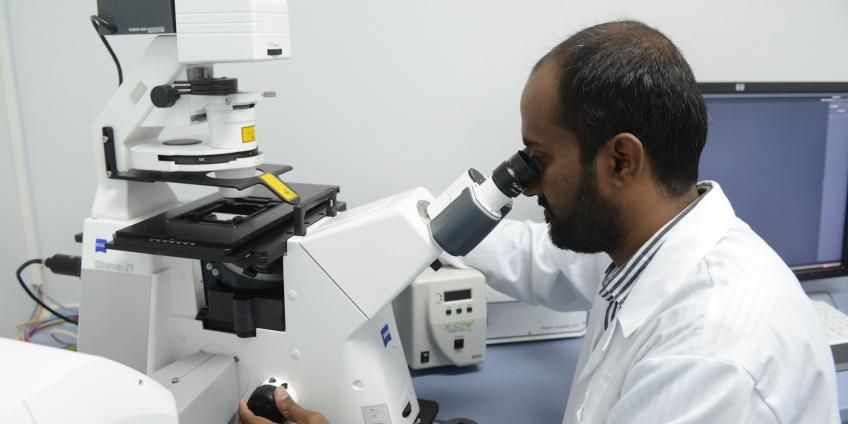
The Electron Microscopy Unit serves as a center of excellence in high-resolution imaging and advanced material characterization. Supporting the research community at IAU, the unit plays a pivotal role in multidisciplinary research spanning medicine, biology, chemistry, physics, and environmental sciences. Staffed by expert faculty, researchers, and technicians, the unit offers state-of-the-art Scanning Electron Microscopy and Energy-Dispersive X-ray (SEM and EDX) and High-Resolution Transmission Electron Microscopy (HR-TEM) services, enabling atomic-level imaging and analysis for both materials science and life science applications. This advanced HR-TEM facility is made possible through generous support from the RDIA governed by Saudi Arabia, under a grant of 4 million Saudi Riyals reinforcing the nation’s commitment to scientific excellence and innovation. Through its comprehensive services and collaborative approach, the Electron Microscopy Unit is committed to advancing innovation, fostering research excellence, and empowering scientists across disciplines.
Research members:
Nanomedicine Research Department
The department is a multidisciplinary entity that bridges chemistry, physics, biomedical sciences, materials science, and engineering. It offers solutions for ecological remediation, environmental sustainability, pharmaceutics, electronics, photocatalysis. The department’s major objectives focus on designing and developing diagnostic and therapeutic nanoformulations for potential cancer therapy and nano-vaccines, synthesizing green metal nanoparticles and nanofibers for antibacterial and antifungal applications, and designing photocatalytic nanomaterials to support environmental sustainability.
Research members:
Clinical Pharmacy Research Department
The department focuses on the development of drug-resistant patterns through genomics, pharmacogenomic research, drug screening, drug docking and drug designing and discovery. The department also emphasizes studying and prioritizing treatment and diagnostic strategies based on targeted symptoms for individuals with autism. In addition to the synthesis of different organic compounds for type II diabetes and Alzheimer’s disease and providing NMR analysis.
Research members:
Epidemic Diseases Research Department
The department of epidemic diseases research strives to lead in the development of innovative solutions to address the unresolved issues of epidemic diseases that can significantly impact health. Among the major research focus of the department include the development of novel vaccine strategies, process development and manufacturing of biologics, as well as the green synthesis of pharmaceuticals. The department has the following laboratories and units:
Nucleic Acid Vaccine Laboratory (NAVL)
Founded in 2021, the NAVL leads research on innovative vaccine approaches using synthetic nucleic acid technologies (pDNA & mRNA). These technologies are powered by the integration of synthetic biology, immunology, and bioinformatics to rationally design vaccine candidates. Accomplishment of the NAVL team include the development of vaccine candidates against MERS-CoV, SARS-CoV-2, and Zika. The NAVL team are also aiming on applying these technologies towards other ranges of emerging pathogens, epidemic diseases, and for pandemic preparedness. Furthermore, the NAVL team are focused on understanding the antigenic landscape of virus surface glycoproteins as well as in preclinical and clinical evaluation of novel vaccine candidates.
Clinical Biomanufacturing Unit (CBMU)
The CBMU is a newly established state-of-the art unit. It offers pre-GMP and cGMP production services of vaccines candidates and other biologics using modern manufacturing approaches. These include manufacturing of (pDNA, mRNA, and subunits) vaccines and mAB therapeutics. The CBMU unit is designed to accommodate the following:
- Process development for Pre-GMP manufacturing.
- Manufacturing optimizations to improve the production yield of vaccines and biologics.
- Early phase I/II GMP manufacturing for vaccines and other biologics.
Molecular Microbiology Laboratory
The team at this lab focuses on applying technical methods for evaluating antimicrobial activities. The lab offers wide ranges of antimicrobial testing services including antibiofilm and virulence, microbial culture characterization, DNA/RNA isolation, biofilms analysis, anti-quorum sensing activity, and regional antibiotic resistance patterns. Furthermore, the team are focused on the synthesis of eco-sustainable green nanomaterials and their application in medicine.
BSL-3 Lab
Designed and built as a biocontainment class-III laboratory, this facility allows scientists to conduct research involving pathogens that are classified as hazard group 3 under optimal confinement conditions. In addition to exploratory research, this lab aims to provide solutions related to the development of new diagnostics or therapeutics for class 3 pathogens, such as MERS-CoV and Mycobacterium tuberculosis.
Research members:
Stem Cell Research Department
The department’s overarching goal is to contribute in the advancement of regenerative medicine by utilizing stem cells in the treatment and replacement of damaged tissues. In order to achieve this goal, the department aims to understand the role and function of stem cells in disease and homeostatic state and develop stem cell-based therapies for treating cancer, neurodegenerative disorders, diabetes, and hematological diseases. Additionally, the department explores the cellular and molecular mechanisms involved in tumor initiation and progression, and constructing diagnostic tools based on the knowledge gleaned from understanding these mechanisms.
Research members:
- Prof. Firdos Alam Khan
- Dr. Sarah Ameen Almofty
- Dr. Dana Almohazey
- Ms. Noor Ali H. Alrushaid
Genetic Research Department
The research scope of the department is to identify genetic mutations underlying various inherited disorders and to enable the application of personalized medicine therapies. The department is committed to developing user-friendly and cost-effective diagnostic assays for broad applications. These diagnostic efforts aim to create commercially viable products (diagnostic kits, gene panels, etc.) to improve disease detection and patient care. Within this scope, the department aims to commercialize several in-house developed products, including a thrombophilia gene panel (targeting five genes), Helicobacter pylori, Mpox, and SARS-CoV-2/Influenza/RSV diagnostic kits.
Research members:

